So with the recent dog attack adventure I got to thinking about how things could have been different.
Lets start out with situational awareness. My 4 year old daughter was walking our dog, I noticed the front door of a house open and 3 large dogs i entry way. All i had time to do was grab my dog from my daughter and say walk faster. In a span of a few seconds the dogs had ran from the house and 1 started attacking my dog.
At this point I had major tunnel vision. All I can recall from the attack was 1 dogs teeth on my dogs neck. Thinking back, I dont remember where the other dogs went, or even what color the attacking dog was. All I remember is yelling at the owners to get their dog off and me punching it as hard as I could. I know I should have been more aware with everything that was going on. Things like, whered the other dogs go? Are there other threats around? My wife told me that one of the people from the house came out with a large kitchen knife. I completely missed that and have no idea if that was to use on their dog, my dog or worse. Another thing that I cant recall at all is the sounds. All i remember is my own voice yelling, my wife said people were crying and that my dog was yelping super loud, but I completely spaced it out.
So now that its over, how do you train for another situation like that? I dont want it to happen again, but if a similar situation occurs, how do I have better awareness for things that are happening?
Last, at what point would you escalate to deadly force? I didnt fear for my life at first, it wasnt until I was on the ground and got bit that I seriously considered using my knife on the animal. Although I think that might have made things worse from a legal perspective and not knowing who the people were from the house. Would they have been the type to get angry and attack me since I killed their dog?
If I had used a firearm (I usually carry on walks but left it at home this time) what does the law say about that if its 2 dogs fighting?
FORUM ARCHIVE — READ ONLY
Read-Only Archive — 68,067 posts · 4,889 threads · 2,978 members · preserved from 2006–2015
Situational awareness, tunnel vision and fight or flight
Dec 08, 2014 02:56 PM #1
Dec 12, 2014 10:29 PM #2
We find that people in stressful situations at work i.e. cardiac arrest or other emergent situation have situation tunnel vision. Over the years I have lost a lot of that and find myself seeing the "whole picture" instead of what is just in front of me. The only way that I know of to alleviate some of that tunnel vision is to put yourself in stressful situations time after time until your adrenaline doesn't flow as much and you are able to see what is around you. That is hard to do when your situation is being attacked by a dog. I would pat you on the back and say well done. I know that your dog is part of your family, like mine are, but the most important thing is that your family came out unharmed.
Hindsight is always 20/20. Use it to prepare yourself for the next situation and your tunnel vision will start to disappear. The police, SWAT, military, and other entities use crisis situation training to "train" out of this tunnel vision response. That is hard to do as a civilian. I could come over and throwthings at you at various surprising times. I live close enough.
Hindsight is always 20/20. Use it to prepare yourself for the next situation and your tunnel vision will start to disappear. The police, SWAT, military, and other entities use crisis situation training to "train" out of this tunnel vision response. That is hard to do as a civilian. I could come over and throwthings at you at various surprising times. I live close enough.
Dec 15, 2014 03:52 PM #3
defibvt wrote:I could come over and throwthings at you at various surprising times. I live close enough.
If this is the plan, then I, too, am more than willing to help a friend. :-)
Dec 16, 2014 08:10 AM #4
I can help
Dec 16, 2014 07:36 PM #5
I heard an interesting fact yesterday that is amazingly relevant to your situation. Thought I'd pass it along so you can be prepared in case this happens again.
"The best way to get a dog to release its bite is to stick something in its rectum."
It mentioned that a finger works really well, but didn't specify how deep you have to go. I would assume that 2 knuckles is plenty. Anyways, I hope this doesn't happen to you again, but at least you'll know how to thwart off future attacks.
*PS - I believe this works on most humans as well.
"The best way to get a dog to release its bite is to stick something in its rectum."
It mentioned that a finger works really well, but didn't specify how deep you have to go. I would assume that 2 knuckles is plenty. Anyways, I hope this doesn't happen to you again, but at least you'll know how to thwart off future attacks.
*PS - I believe this works on most humans as well.
Dec 16, 2014 08:27 PM #6
This is a very helpful site
Dec 17, 2014 07:29 AM #7
First, I'm glad things turned out somewhat OK, and not worse. My comment on your other FB post may have been a little short, but it was my mindset. It's always my mindset. It's part of my training and falls in line with this post. Situational Awareness.
In my years, I've been asked many times I get asked a similar question, "are you a cop"? I get asked this because I am very cautious of my surroundings. Whenever I walk into a new establishment I consciously (and immediately) scan the room. I look for faces, hands, how people stand, what they are wearing, what they are carrying, where the exits are, natural cover and concealment locations, locate my desired seating area so I can maintain visual of all that can protect me, and I formulate an escape/defend plan. Then, I also listen to the noises around me, the temperature of the area and the odors within my field of smell. All this happens in a few seconds. These things are part of Situational Awareness Training. I am always in Condition Yellow, unless I am sleeping or dead. I will explain "Condition Yellow" later.
Is it hard to get yourself to do this? No. It just requires a change in routine and your thought process.
"Awareness" is a choice. You have to choose to be alert and to pay attention. Once chosen your brain will go to work and maintain your scans and look for changes in the norm. What you previously scanned is a called your Baseline. If the baseline changes, the eyes inform the brain and your brain makes your body react. Such actions happen immediately and will give you time to initiate proper handling methods. How do you know if the baseline has changed? Well, you repeat your observation regularly. This is done by all your senses and it takes only a split second. In most cases, this happens subconsciously.
Unfortunately, there are always things that tend to distract you, and your focus on awareness get interrupted. Each time a distraction happens you have reinitialize your choice of awareness, and repeat the process. Again, it only takes seconds.
How do I defend or fight? What tools do I have at my disposal? Hopefully, you have your EDC (every day carry) pocket knife or pistol. If you are defending your life, you should have some tool of defense. You may not always be able to carry your firearm, but a 4" pocket knife is generally acceptable. Even a sharp stabbing tool like a ballpoint pen can aid in your survival. In most cases, your hands may not be enough. Best weapon of all, your brain. Stay alert and avoid the danger, before it materializes.
Here are some study aides. Please take a moment and review them.
The great Colonel Jeff Cooper came up with a Color Code of Situational Awareness. Review this video. Avoid Condition White unless you're sleeping or dead. Stay in Condition Yellow and it may keep you out of danger. Jump to Condition Orange if your "Spidy Senses" start to tingle, and Condition Red when it's time to choose: Fight or Flight, get ready to react. Condition Black. Fight for survival.
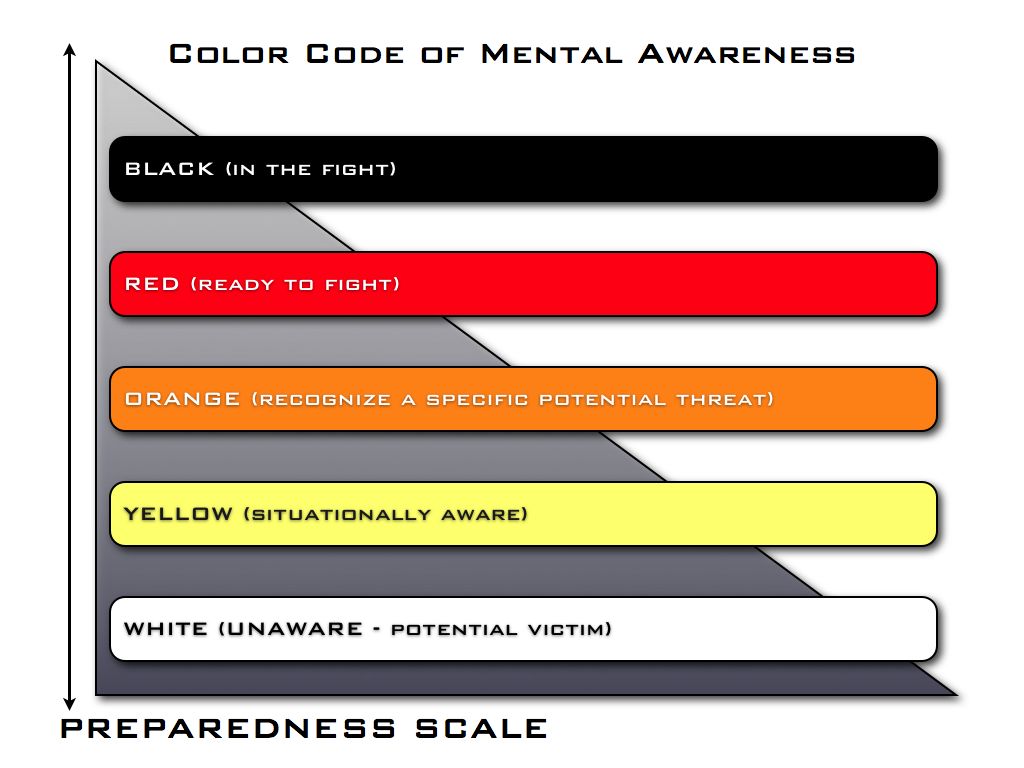
Image Credit
ITS Tactical did a wonderful write-up about effective techniques to stay aware and avoid the distraction. Below is the article:
=====================
Situational Awareness
I have spent a fair amount of time over the past several years trying to define and refine my understanding of the term “Situational Awareness.”
Most of the written material deals with very technical definitions, that for me hold little real world application. As I tried to make them fit my own experience with awareness, I realized that the academic approach was impractical.
So here’s how I defined “situational awareness.” It is: “paying attention to what is going on around you.” How’s that for practical? It’s more than that, but the basic definition is the ability to scan the environment and sense danger, challenges and opportunities, while maintaining the ability to conduct normal activities. In other words, to pay attention to your surroundings while not appearing to be paying attention.
Understanding the Baseline
Awareness is a choice. One has to choose to pay attention. But once that choice is made, the part of the brain responsible for monitoring the senses, known as the Reticular Activating System (RAS) takes over. It switches filters on and off that will fulfill your subconscious desire to pay attention. By simply telling yourself to pay attention to certain things, the RAS will scan for and acknowledge those things when it encounters them.
I have found three main obstacles to developing awareness. To understand the obstacles with awareness, lets define the most basic tenant of awareness: BASELINE. The concept of baseline states that our environment has a baseline, a homeostatic state of what things look like, sound like and feel like when nothing much is going on.
In the woods, this is reflective of the noise and activity level of the area when nothing much is happening. The normal state. For example, in the late afternoon, things are normally pretty quiet. The baseline is pretty flat. As we move into evening, the baseline changes a bit. Night feeding animals are coming out, day feeders are going in.
The increase in noise and activity is still the norm. It is louder and yet still within the realm of normal. Suddenly a predator appears. All the prey animals react. Alarm calls go out and the noise level suddenly spikes. This is referred to as a concentric ring of disturbance because it radiates out from the source.
In the city, each neighborhood has its own baseline. In one area, people move at a certain pace, talk at a certain volume, stand at a certain socially acceptable distance from one another, gesture in a certain way. This combination of noise and activity constitutes that area’s baseline. Depending on cultural or ethnic norms, it will be different in various neighborhoods.
Being able to develop awareness is dependent upon first knowing the baseline for the area you are in and recognizing any variations to the baseline. These changes in baseline are learned from observation. One must know the baseline. One must recognize disturbances to the baseline and one must recognize if those disturbances represent a specific threat or opportunity.
This requires knowledge of the environment, knowledge of terrain. It requires that one recognizes predator behavior. It requires one to see well beyond normal sight. For example, an aware person will notice things others may miss: a youth in a hoodie across the street whose movements mimic yours. Or a dumpster set in such a way that requires you to pass close to it. It can be threats or potential threats. You must constantly monitor and assess. Over time, this becomes almost a background activity, requiring little conscious thought.
The key to great situational awareness is the ability to monitor the baseline and recognize changes.
Three Obstacles In Situational Awareness
1. Not Monitoring the Baseline. If you are not monitoring the baseline, you will not recognize the presence of predators that cause a disturbance. Other events can cause concentric rings as well. Any unusual occurrence from a car accident to a street fight can create a concentric ring. One of the keys to personal security is learning to look for and recognize these disturbances. Some disturbances are dangerous, some are just entertaining.
2. Normalcy Bias. Even though we may sense a concentric ring that could be alerting us of danger, many times we will ignore the alert due to the desire for it NOT to be a danger. We want things to be OK, so we don’t accept that the stimulus we’re receiving represents a threat. We have a bias towards the status quo. Nothing has ever happened when I do this, so nothing is likely to happen.
3. The third interrupter of awareness is what we define as a Focus Lock. This is some form of distraction that is so engaging, that it focuses all of our awareness on one thing and by default, blocks all the other stimulus in our environment. This is when someone is texting and walks into a fountain. The smart phone is the single most effective focus lock ever invented. It robs us of our awareness in times and places where it’s needed most.
Three Effective Techniques To Stay Aware
1. Monitor the Baseline. At first, this will require conscious effort. But after a while, I find that I can monitor the baseline subconsciously.
2. Fight Normalcy Bias. This requires you to be paranoid for a while as you develop your ability. Look at every disturbance to the baseline as a potential threat. This will allow you to stop ignoring or discounting concentric rings and begin making assessments of the actual risk. But as you learn, people will think you are jumpy or paranoid. That is OK. It’s a skill that will save your life.
3. Avoid using the obvious focus locks in transition areas. It is ok to text while you are sitting at your desk or laying in bed. But it’s NOT ok to text as you walk from your office to the parking garage.
Any time you’re drawn to a concentric ring event, do a quick assessment of that ring, then stop looking at it (the event) and scan the rest of your environment to see what you’re missing.
Developing awareness is a skill. At first it will seem very awkward and self-conscious, but with practice, it will become seamless and subconscious. You will start to pick up on more and more subtle rings of disturbance and more complex stimuli. Eventually, people may think you are psychic as they notice how you seem to sense events before they unfold.
In my years, I've been asked many times I get asked a similar question, "are you a cop"? I get asked this because I am very cautious of my surroundings. Whenever I walk into a new establishment I consciously (and immediately) scan the room. I look for faces, hands, how people stand, what they are wearing, what they are carrying, where the exits are, natural cover and concealment locations, locate my desired seating area so I can maintain visual of all that can protect me, and I formulate an escape/defend plan. Then, I also listen to the noises around me, the temperature of the area and the odors within my field of smell. All this happens in a few seconds. These things are part of Situational Awareness Training. I am always in Condition Yellow, unless I am sleeping or dead. I will explain "Condition Yellow" later.
Is it hard to get yourself to do this? No. It just requires a change in routine and your thought process.
"Awareness" is a choice. You have to choose to be alert and to pay attention. Once chosen your brain will go to work and maintain your scans and look for changes in the norm. What you previously scanned is a called your Baseline. If the baseline changes, the eyes inform the brain and your brain makes your body react. Such actions happen immediately and will give you time to initiate proper handling methods. How do you know if the baseline has changed? Well, you repeat your observation regularly. This is done by all your senses and it takes only a split second. In most cases, this happens subconsciously.
Unfortunately, there are always things that tend to distract you, and your focus on awareness get interrupted. Each time a distraction happens you have reinitialize your choice of awareness, and repeat the process. Again, it only takes seconds.
How do I defend or fight? What tools do I have at my disposal? Hopefully, you have your EDC (every day carry) pocket knife or pistol. If you are defending your life, you should have some tool of defense. You may not always be able to carry your firearm, but a 4" pocket knife is generally acceptable. Even a sharp stabbing tool like a ballpoint pen can aid in your survival. In most cases, your hands may not be enough. Best weapon of all, your brain. Stay alert and avoid the danger, before it materializes.
Here are some study aides. Please take a moment and review them.
The great Colonel Jeff Cooper came up with a Color Code of Situational Awareness. Review this video. Avoid Condition White unless you're sleeping or dead. Stay in Condition Yellow and it may keep you out of danger. Jump to Condition Orange if your "Spidy Senses" start to tingle, and Condition Red when it's time to choose: Fight or Flight, get ready to react. Condition Black. Fight for survival.
Image Credit
ITS Tactical did a wonderful write-up about effective techniques to stay aware and avoid the distraction. Below is the article:
=====================
Situational Awareness
I have spent a fair amount of time over the past several years trying to define and refine my understanding of the term “Situational Awareness.”
Most of the written material deals with very technical definitions, that for me hold little real world application. As I tried to make them fit my own experience with awareness, I realized that the academic approach was impractical.
So here’s how I defined “situational awareness.” It is: “paying attention to what is going on around you.” How’s that for practical? It’s more than that, but the basic definition is the ability to scan the environment and sense danger, challenges and opportunities, while maintaining the ability to conduct normal activities. In other words, to pay attention to your surroundings while not appearing to be paying attention.
Understanding the Baseline
Awareness is a choice. One has to choose to pay attention. But once that choice is made, the part of the brain responsible for monitoring the senses, known as the Reticular Activating System (RAS) takes over. It switches filters on and off that will fulfill your subconscious desire to pay attention. By simply telling yourself to pay attention to certain things, the RAS will scan for and acknowledge those things when it encounters them.
I have found three main obstacles to developing awareness. To understand the obstacles with awareness, lets define the most basic tenant of awareness: BASELINE. The concept of baseline states that our environment has a baseline, a homeostatic state of what things look like, sound like and feel like when nothing much is going on.
In the woods, this is reflective of the noise and activity level of the area when nothing much is happening. The normal state. For example, in the late afternoon, things are normally pretty quiet. The baseline is pretty flat. As we move into evening, the baseline changes a bit. Night feeding animals are coming out, day feeders are going in.
The increase in noise and activity is still the norm. It is louder and yet still within the realm of normal. Suddenly a predator appears. All the prey animals react. Alarm calls go out and the noise level suddenly spikes. This is referred to as a concentric ring of disturbance because it radiates out from the source.
In the city, each neighborhood has its own baseline. In one area, people move at a certain pace, talk at a certain volume, stand at a certain socially acceptable distance from one another, gesture in a certain way. This combination of noise and activity constitutes that area’s baseline. Depending on cultural or ethnic norms, it will be different in various neighborhoods.
Being able to develop awareness is dependent upon first knowing the baseline for the area you are in and recognizing any variations to the baseline. These changes in baseline are learned from observation. One must know the baseline. One must recognize disturbances to the baseline and one must recognize if those disturbances represent a specific threat or opportunity.
This requires knowledge of the environment, knowledge of terrain. It requires that one recognizes predator behavior. It requires one to see well beyond normal sight. For example, an aware person will notice things others may miss: a youth in a hoodie across the street whose movements mimic yours. Or a dumpster set in such a way that requires you to pass close to it. It can be threats or potential threats. You must constantly monitor and assess. Over time, this becomes almost a background activity, requiring little conscious thought.
The key to great situational awareness is the ability to monitor the baseline and recognize changes.
Three Obstacles In Situational Awareness
1. Not Monitoring the Baseline. If you are not monitoring the baseline, you will not recognize the presence of predators that cause a disturbance. Other events can cause concentric rings as well. Any unusual occurrence from a car accident to a street fight can create a concentric ring. One of the keys to personal security is learning to look for and recognize these disturbances. Some disturbances are dangerous, some are just entertaining.
2. Normalcy Bias. Even though we may sense a concentric ring that could be alerting us of danger, many times we will ignore the alert due to the desire for it NOT to be a danger. We want things to be OK, so we don’t accept that the stimulus we’re receiving represents a threat. We have a bias towards the status quo. Nothing has ever happened when I do this, so nothing is likely to happen.
3. The third interrupter of awareness is what we define as a Focus Lock. This is some form of distraction that is so engaging, that it focuses all of our awareness on one thing and by default, blocks all the other stimulus in our environment. This is when someone is texting and walks into a fountain. The smart phone is the single most effective focus lock ever invented. It robs us of our awareness in times and places where it’s needed most.
Three Effective Techniques To Stay Aware
1. Monitor the Baseline. At first, this will require conscious effort. But after a while, I find that I can monitor the baseline subconsciously.
2. Fight Normalcy Bias. This requires you to be paranoid for a while as you develop your ability. Look at every disturbance to the baseline as a potential threat. This will allow you to stop ignoring or discounting concentric rings and begin making assessments of the actual risk. But as you learn, people will think you are jumpy or paranoid. That is OK. It’s a skill that will save your life.
3. Avoid using the obvious focus locks in transition areas. It is ok to text while you are sitting at your desk or laying in bed. But it’s NOT ok to text as you walk from your office to the parking garage.
Any time you’re drawn to a concentric ring event, do a quick assessment of that ring, then stop looking at it (the event) and scan the rest of your environment to see what you’re missing.
Developing awareness is a skill. At first it will seem very awkward and self-conscious, but with practice, it will become seamless and subconscious. You will start to pick up on more and more subtle rings of disturbance and more complex stimuli. Eventually, people may think you are psychic as they notice how you seem to sense events before they unfold.