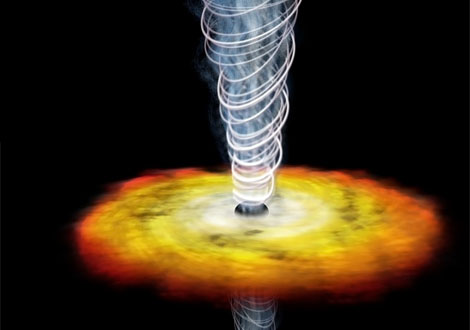
With the Large Hadron Collider firing up for the first time Wednesday, there is also a very, very remote chance that the process will spawn black holes—any one of which could assume an odd orbit within Earth, devouring microscopic chunks of matter until the entire planet is gone, physicists say.
National Geographic Article Link
If a black hole did form and begin eating Earth, there would be no spectacular display, Feng said.
"This tiny little black hole grows little by little and starts eating up the Earth," he said.
"It has to loop back, and it's a little bit like a comet that has an orbit that keeps going through the Earth."
After absorbing the entire Earth—how long it would take is unclear—the black hole would be nearly the size a golf ball but would have the same mass as Earth did before it was gobbled up.
The baby black hole would simply take Earth's place in the solar system, Feng said.
"The moon would be orbiting around this little 'golf ball,' and the other planets would orbit just as they are now," he added.
And even with the most sophisticated of observational techniques, potential intelligent beings in another galaxy would be oblivious to the change.
The lights of Earth would of course be gone, "but the fact is that no one can see that anyway," because the illumination is simply too faint for intergalactic detection.